

How Coffee Bean Density Influences Your Roasting Process
Producing an exceptional cup of coffee depends not only on roasting techniques but also on the quality of the coffee beans themselves. Because of this, coffee roasters often take time to assess and better understand bean characteristics before the roasting process begins. One criterion that is commonly analyzed is bean density. Why does this factor matter so much, and how does it influence the roasting process? Let’s explore this further in this article!

What Is Coffee Bean Density?
Coffee bean density refers to the compactness of a coffee bean and is typically defined as the ratio between its mass and its volume. In simple terms, it describes how tightly the cells inside the bean are packed. Beans with tighter and smaller cell structures are generally categorized as high-density, while beans with a more porous and loose structure are considered low-density.
One of the most common factors influencing bean density is the altitude at which the coffee is grown. In higher-altitude regions, coffee cherries tend to mature more slowly due to cooler and more stable temperatures throughout the year. This slower maturation process makes the beans develop a denser internal structure. Besides altitude, other factors such as coffee variety and coffee processing methods can also influence the final density of the beans.
In the coffee industry, many coffee roasters associate high-density beans with higher quality. The reason behind this is that slower development often leads to higher concentrations of sugars and organic acids, which can contribute to a more complex and sweeter flavor profile in the cup.
Impacts of Coffee Bean Density in the Roasting Process
Since coffee bean density reflects the internal cellular structure of the bean, it directly affects how heat is transferred and absorbed throughout the roasting process. Beans with higher density tend to absorb heat more slowly, meaning the heat takes longer to penetrate to the center. That’s why higher-density beans often benefit from a stronger initial heat input and can usually tolerate higher charge temperatures. Lower-density coffee beans, on the other hand, absorb heat more quickly and are more vulnerable to roast defects like scorching if exposed to excessive heat early in the roast.
Bean density also influences how roast development progresses. As the roast approaches first crack, these beans tend to reach this stage later than lower-density beans under similar conditions.
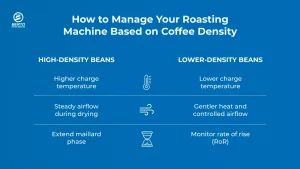
How to Manage Your Roasting Machine Based on Coffee Density
You can’t always use the same roast settings for coffees with different bean densities, as they can produce very different results in the final cup. To bring out the best flavor, it’s important to adjust your roasting variables (airflow and charge temperature) and roast beans with different densities individually. Here are some practical ways to adjust your roasting machine based on the coffee beans’ density:
1. Roasting High-Density Coffee Beans
- Use a slightly higher charge temperature
Since high-density coffee beans can tolerate higher initial charge temperatures, providing sufficient energy early in the roast helps heat gradually penetrate the bean’s dense internal structure. This will support more even heat distribution throughout the roasting process. - Maintain steady airflow during drying
Consistent airflow helps remove moisture released during the drying phase while keeping heat transfer stable inside the roasting drum, supporting a more controlled drying stage and promoting more even development in dense beans. - Extend the Maillard phase for sweetness development
Extending the Maillard reaction slightly can deepen browning reactions that contribute to sweetness and body in the cup. This approach was used by 2018 U.S. Roasting Championship winner Ian Picco, who extended the drying and Maillard phases when roasting Kenyan SL-34 to emphasize sweetness and body while preserving aromatic complexity.
2. Roasting Lower-Density Coffee Beans
- Use a lower initial charge temperature
In contrast to high-density beans, lower-density coffee beans often perform better when roasted with a slightly lower charge temperature or gentler initial heat. Such a method helps prevent the bean tips from overheating too quickly (tipping) during the early stages of roasting. - Apply gentler heat and adjust airflow during the early roast
Reducing aggressive heat input and maintaining appropriate airflow can reduce the risk of scorching and assist in removing moisture released during the drying phase for more stable heat transfer and even development. - Monitor Rate of Rise (RoR) carefully
Maintaining a controlled rate of rise (RoR) allows the roast curve to progress more smoothly and reduces the risk of sudden temperature increases or spikes. These spikes, sometimes referred to as “flicks” on the roast graph, can lead to uneven development and may result in harsher or less complex flavor characteristics in the final cup.
Achieve Precise Control Over Bean Density with Berto Roaster
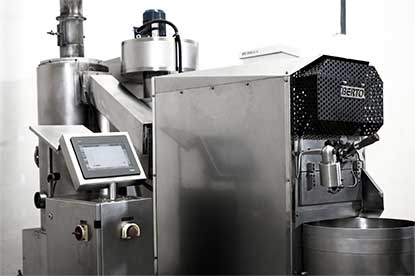
Adjusting roasting variables based on coffee bean density becomes much easier when your roasting machine is built for precise control, like Berto Roaster. Our machine is designed with BertoLogic™, helping you to fine-tune roasting variables with greater accuracy and consistency.
Each machine also features an intuitive control panel that enables precise adjustments and responds quickly to changes in airflow and temperature during the roasting process. Once you achieve the ideal roast profile, the data can be recorded using external software such as Artisan or Cropster to maintain consistency from batch to batch. For more advanced control, the Berto Type R Roaster includes an integrated PID controller that allows roast variables to be recorded and replicated directly from the machine.
So no matter the density of your coffee beans, Berto Roaster gives you the control needed to bring out the best possible results in the cup. Connect with our team today, and we will help you find the roasting machine that best fits your needs.
Related Roasters

Related Article
The Impact of Altitude on Coffee Roasting Profiles

Related Article
Coffee Processing Methods: Natural, Washed, Honey

Related Article
Coffee Roast Defect: How to Avoid Tipping & Scorching?


Related Article
Understanding the Maillard Reaction in Coffee Roasting

Related Article
