
What Coffee Roasters Must Know About Roasting Decaf Coffee Beans
Decaffeinated coffee, or decaf, is coffee made from beans with at least 97% of their caffeine removed. It has become a popular alternative for people who love coffee but are sensitive to caffeine or need to watch their intake for health reasons.
However, caffeine is not the only thing that sets decaf coffee apart. The roasting process also behaves differently, which is why coffee roasters need to understand the processing method and the bean’s characteristics before starting to roast. In this article, we will explore decaf coffee beans from the green bean stage all the way through to the roasting process. Let’s get started!

The Story Behind Decaf Coffee Beans
The man behind decaf coffee is closely tied to Ludwig Roselius. In 1905, he began investigating the health risks of caffeine, driven by the belief that it had contributed to his father’s death. This curiosity led him to explore ways to remove caffeine from coffee while preserving its drinkability.
His breakthrough came somewhat unexpectedly. While transporting coffee beans on a voyage, he noticed that the beans’ caffeine levels had been reduced after being soaked in seawater. This observation inspired him to experiment further by steaming the beans and using benzene (a chemical solvent) to extract the remaining caffeine. He later patented the decaffeination process, which marked the beginning of the global decaffeination industry.
Now, decaf coffee continues to grow steadily worldwide. Europe remains a leading market with over 35% of global revenue, while the Asia-Pacific region is the fastest-growing market due to rising awareness of caffeine’s health effects in countries like India, Indonesia, and Japan.
Decaf Coffee Process Methods You Should Know
Benzene, once used in the decaf coffee process, was replaced with safer alternatives after being identified as a carcinogen. Here are several decaffeination methods commonly used today and how each one affects the coffee.
Direct & Indirect Solvent Decaffeination
These methods use safer chemical solvents such as ethyl acetate or methylene chloride to remove caffeine.
- The direct method: coffee beans are first steamed to open their pores, then rinsed with a solvent that draws out the caffeine. Afterward, the beans are steamed once more to remove any remaining solvent, then dried and prepared for roasting.
- The indirect method: the beans are soaked in hot water to extract both caffeine and flavor compounds. The water is then separated and treated with one of those solvents to remove the caffeine before being returned to the beans to reabsorb much of their original flavor.
Water-Based Decaffeination
Also known as the Swiss Water Process, this method uses green coffee extract (GCE), a natural and solvent-free solution, to remove caffeine while preserving the coffee’s flavor compounds.
The beans are soaked in this extract, which removes the caffeine without taking away most of the coffee’s flavor compounds. After the caffeine is removed, the beans are gently dried using controlled airflow and low temperatures to maintain their moisture and overall quality. This method is also considered a more environmentally conscious option, as the used GCE is filtered through carbon to remove the caffeine and then reused in a continuous cycle.
Carbon Dioxide (CO₂) Decaffeination
A more advanced decaffeination method uses pressurized supercritical carbon dioxide (sCO₂) to extract caffeine from coffee beans. The beans are first soaked in water, then exposed to CO₂ under high pressure, where it acts like a magnet that attracts and pulls the caffeine out of the beans. After the process, the beans are dried and prepared for roasting.
This method is highly effective at removing caffeine while preserving the coffee’s flavor compounds, as CO₂ naturally only targets caffeine without affecting the carbohydrates and proteins in the beans. It is also considered environmentally friendly, as the CO₂ can be captured and reused in a continuous cycle.
Things to Consider Before Roasting Decaffeinated Coffee
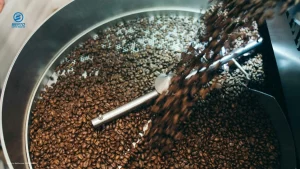
Repeated steaming and soaking during the decaffeination process gradually change the bean’s structure, which makes roasting decaf coffee beans slightly different from roasting regular coffee. Here are a few things to keep in mind before you start:
1. Don’t Rely Heavily on Color
Decaf coffee beans often appear slightly darker or more muted in their green state than regular beans, due to their more porous and less dense structure. As a result, they change color much more quickly during roasting, even though the inside has not fully developed.
2. Roast Slower and Gentler
The porous structure and lower density of decaf coffee beans also cause them to absorb heat more quickly than regular beans. This means applying high charge temperatures or too much gas too early can increase the risk of scorching and tipping. As a general rule of thumb, lowering the charge temperature by 5 to 15°C compared to regular coffee is a good place to start.
3. Monitor the Rate of Rise Closely
Since coffee color is not always a reliable indicator with decaf, keeping an eye on the Rate of Rise (RoR) becomes your best guide. During the drying phase, aim for a steady climb after the turning point to build enough momentum in the roast. As you move into the Maillard phase, allow the RoR to decline gradually and smoothly, avoiding any flat or rising segments as these can often lead to roast defects.
4. Be Careful Around Second Crack
Pushing decaf beans into second crack can be tricky because the first crack is often very quiet or easy to miss. By the time you hear a clear pop, you may already be closer to second crack than expected. On top of that, their “leaky sponge” like structure causes decaf beans to release moisture and gases more quickly, leaving a very narrow window before they reach second crack.
For better flavor balance, it is usually best to end the roast shortly after first crack or just slightly beyond it to achieve enough development while avoiding harsh, overdeveloped notes.
5. Cool the Beans Quickly
Just like regular beans, decaf coffee beans need to be cooled down immediately after roasting to avoid overcooking from residual heat. Increase your fan speed right away and cool the beans as quickly and evenly as possible.
6. Lastly, Log Your Best Results!
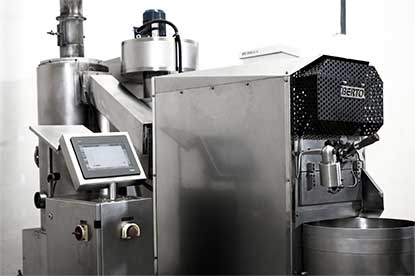
Make sure to log your best roasts using notes or roasting software so you can repeat and refine your results over time. With Berto Roaster, you can achieve consistent and repeatable results in a single machine. It is built with BertoLogic™ and equipped with the features professional roasters need for precise and accurate roasting.
The machine can also be integrated with software like Cropster or Artisan, while Berto Type R Roaster offers more advanced features that let you record roasts directly on the machine using its built-in PID controller.
Connect with us today to learn how Berto Roaster can help your decaf roasts reach the quality they deserve!
Related Roasters
Related Article
Which Coffee Roast Has the Most Caffeine?

Related Article
Understanding Moisture Levels in Coffee Beans
Related Article
How Can Coffee Roasters Be Sustainable?

Related Article
How Coffee Bean Density Influences Your Roasting Process

Related Article
Coffee Roast Defect: How to Avoid Tipping & Scorching?
Related Article
Fine-Tune Your Bean Profile with Coffee Color Analysis

Related Article
Understanding the Rate of Rise (RoR)
Related Article
Understanding the Maillard Reaction in Coffee Roasting

Related Article
First Crack vs. Second Crack: What They Mean for Your Roast
Related Article
