The Roaster’s Guide to Managing Environmental Changes in the Coffee Roasting Process
Have you ever used the same green coffee and roast profile but ended up with a different result than the previous batch? The cause may be changes in your roastery environment that you don’t notice.
Things like weather conditions and the time of day can change the environment inside your roastery and affect the coffee roasting process. So every coffee roaster needs the skill to understand these changes and adjust the roasting process to get consistent roasts.
In this blog, we’ll explore the factors that influence your roastery environment and share practical steps for managing them.

How Environmental Changes Alter Your Roast
Coffee roasting relies on precise heat transfer to transform green coffee beans into aromatic roasted coffee. In physics, energy transfer occurs as heat naturally flows from hotter to cooler areas. During the coffee roasting process, heat supplied by the roasting machine is transferred to the coffee beans, while some is also lost to the surrounding environment.
This is where roastery conditions begin to matter. On a hot afternoon, the temperature difference between the machine and the surrounding air is smaller, which can slightly reduce heat loss and often make the machine more responsive. But during an early morning roast that is typically cooler, the greater temperature difference can increase heat loss, meaning the roasting machine may require more energy to maintain stable conditions.
So, when using the same roasting settings under different environmental conditions, your next batch is likely to have different results because the roasting process may take longer or shorter.
Environmental Factors That Affect the Coffee Roasting Process
Besides differences in roasting time, changes in environmental conditions can also be caused by natural factors or daily habits that, without you realizing it, may influence the coffee roasting process. Let’s break down the causes one by one:
Ambient Temperature
Ambient temperature is simply the temperature of the air inside your roastery. When it’s higher, your machine usually needs less energy to reach and hold temperature. When it’s lower, you might notice the warm-up takes longer, since more heat is lost to the cooler air around it.
These shifts often come from seasonal changes. Think dry versus rainy seasons in tropical climates, or winter and summer in places with four seasons. Other than nature, changes in ambient temperature can also come from day-to-day actions, like running the air conditioning during a roast or between batches.
Humidity
Humidity is another environmental factor that shifts with weather and seasonal conditions. It can play a role in how green coffee behaves once it charges into the machine, though its effect during the roast itself is smaller than the ambient temperature.
Roasting in higher humidity can slow the drying stage because the surrounding air already holds more moisture and can’t absorb as much from the bean. But lower humidity has the opposite effect, with beans drying more quickly due to faster evaporation.
Humid environments can also affect green coffee if it’s not stored properly. Coffee is hygroscopic, meaning its cellular structure absorbs or releases moisture based on the surrounding air. When coffee beans have extra moisture content, they tend to absorb heat differently during the roasting process compared to beans stored under stable and controlled conditions.
Ventilation and Airflow in the Roastery
Ventilation is really important for safety, but did you know it also contributes to roasting consistency? As multiple batches are roasted, heat and exhaust accumulate in the roasting space and gradually raise the room temperature. If the roastery doesn’t have proper ventilation, the roasting machine will draw back that hot air and make the airflow unstable, as well as make the next batch run at a different temperature from the last one.
Everyday activities that are easy to overlook can also shift airflow, like opening a large door or window during a roast. These sudden changes in incoming air can temporarily disrupt airflow patterns and system stability.
Practical Ways to Manage Environmental Changes
Not all environmental changes can be controlled since nature also plays its part. But you can build awareness of your roastery conditions through preparation and small adjustments. Here are a few practical ways to manage them:
1. Monitor Conditions Before Every Roast Session
Before every session, check the ambient temperature and humidity in your roastery. A simple hygrometer and thermometer are all you need. Log these readings alongside your roast data and you’ll start spotting patterns that make adjustments easier and more informed.
2. Adjust Charge Temperature to Match the Conditions
You can lower the charge temperature slightly when roasting on hotter days or during peak afternoon heat to compensate for the higher ambient temperature in the roastery space. For cooler mornings or in cold weather, raise the charge temperature or extend your pre-heat time to give the machine a stable starting point before charging the beans.
3. Create Your Seasonal Profiles
Another way to improve consistency (especially for you who prefer not to chase reactive adjustments every season) is to create separate roast profile settings for different seasonal or weather conditions. Label them clearly in your roasting software for the same coffee beans, such as “wet/rainy season profile” and “dry season profile”. You’ll get a reliable starting point in each roast and save more time because you don’t need to adjust from scratch whenever conditions shift.
4. Control What You Can Inside the Roastery
Try not to roast coffee beans directly under an open window or near an air-conditioning vent, as this can cause sudden temperature changes. It’s also important to store your coffee beans in airtight, moisture-resistant containers to prevent them from absorbing excess moisture when environmental conditions change.
5. Consider a Roasting Machine With a Recirculated Convection System
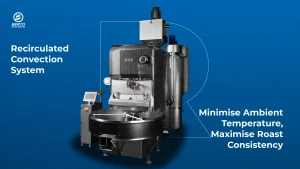
Modern coffee roasting machines are now equipped with technologies that help roasters manage changing environmental conditions. One example is the recirculated convection system on Berto Type R Roaster. This system recirculates the hot air generated during roasting instead of relying on outside air. With this internal air circulation, heat transfer stays more stable and far less affected by changes in ambient temperature.
You’ll experience a consistent roast profile from one batch to the next, without having to worry about changing conditions around your roastery.
Learn more about Berto Roaster lineup, or reach out to our team if you’d like to discuss your roasting needs and find the perfect machine for your roasting operation.
Related Roasters

Related Article
Understanding Heat Transfer Inside The Coffee Roaster Machine

Related Article
Understanding Moisture Levels in Coffee Beans


Related Article