
Let’s Clear Up Common Coffee Roasting Terms That are Easy to Mix Up
Mastering the process of transforming green beans into roasted beans requires coffee roasters to follow various techniques and technical steps. To make these easier to communicate and understand, the coffee roasting community has developed specific terms for them. There’s even a dedicated glossary, almost like learning a new language.
Unfortunately, some of these coffee roasting terms sound and look similar, so they’re often used interchangeably when they shouldn’t be. In some cases, misunderstandings can occur that disrupt the roasting process or affect the final roast.
This article will discuss several terms in the coffee roasting process that are often misunderstood, helping you understand the differences and avoid mistakes when applying them.

Bean Temperature (BT) vs. Rate of Rise (RoR)
Bean Temperature (BT) is the actual temperature of the coffee beans during the roast. It shows how hot the beans are at any given moment, helping the roaster understand which stage of the roast they are in.
Meanwhile, Rate of Rise (RoR) measures how quickly the bean temperature is increasing, usually in degrees per minute. In a nutshell, BT tells you how hot the beans are right now, while RoR tells you how fast that temperature is rising.
Beginner roasters often confuse distinguishing between the two because RoR is calculated from BT data. Both are also displayed on the same graph in roasting software. This makes the two lines look similar or visually confusing even though they represent different information.
The easiest way to tell them apart is by looking at the shape of the graph. The BT curve usually drops slightly after the beans are charged into the roaster, then rises steadily until the end of the roast (usually like a checkmark symbol). In contrast, the RoR curve rises at the beginning, reaches a peak and then gradually declines for the rest of the roast.
Development Time vs. Development Time Ratio (DTR)
Both metrics focus on the period after first crack, and because DTR is closely related to Development Time, it’s easy to think they measure the same thing.
Development Time is simply the time between the start of first crack and the moment the beans are dropped into the cooling tray. It is measured in minutes and seconds. Development Time Ratio (DTR) uses that same period but expresses it as a percentage of the total roast time. Usually using the formula: (DTR = Development Time / Total Roast Time x 100%).
Here’s why the difference matters. Let’s say you have two roasts (‘Roast A’ and ‘Roast B ‘) with the same 2-minute Development Time, but the total roast time is different.
- Roast A has a total roast time of 8 minutes, giving it a 25% DTR.
- Roast B has a total roast time of 12 minutes, giving it a 16.7% DTR.
This means Roast A spends a larger proportion (or percentage) of its total roast in the development stage than Roast B. The differences can lead to different flavor profiles in the final cup, even with identical development times.
Maillard Reaction vs. Caramelization
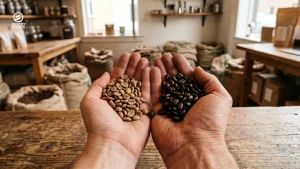
Maillard reaction and caramelization produce a brown color in coffee beans, which leads some people to think they’re just two names for the same chemical process. But let’s look at their definitions first.
The Maillard reaction happens between reducing sugars and amino acids. It starts earlier in the roast, somewhere around 140°C–150°C. You’ll notice the coffee looks light brown and still has a dry, matte surface.
At higher temperatures, usually from around 170°C and above, caramelization becomes more noticeable. This process is only the thermal breakdown of sugars, without any amino acids involved. The higher temperature also means caramelization tends to build after the Maillard reaction has already started, giving beans a darker brown color with a shinier, almost glossy surface.
Another way to spot the differences between these two is when tasting the coffee. The Maillard reaction often produces nutty, toasted, malty, or chocolate-like flavours. Caramelization contributes sweeter notes, such as caramel, toffee, and burnt sugar, like adding more richness and depth to the cup.
Scorching vs. Tipping
Scorching and tipping are two roasting defects that coffee roasters commonly encounter. Both leave dark burn marks on the beans, and at first glance, they can look the same. But they have different causes and appear in different locations on a bean, so it’s important to know each defect before you try to fix it.
Scorching tends to happen when the charge temperature is too high, the machine is overfilled, or the drum is spinning too slowly. The flat surface of the bean ends up sitting against the hot drum for too long, leaving dark burn marks on that area.
Tipping shows up when the heat you apply is too aggressive for the beans to absorb evenly. The thinnest part of the bean (its edge or tip) ends up taking the damage and leaves a small burn spot. That’s why it’s called “tipping”.
For tips on preventing these roasting defects, check out our blog on how to avoid scorching and tipping.
Roast Quality Vs. Roast Development
Roast quality is about how a coffee tastes and feels in the cup, things like sweetness, balance, and body. Development is a different thing. It’s part of the coffee roasting process itself, specifically what happens to the bean from the first crack to the end of the roast. You can track and measure it as the roast happens, but you can’t taste it directly.
The problem is these two ideas often get mixed up, especially when “developed” becomes a catch-all word. Coffee roasters often say a coffee is “underdeveloped” or “overdeveloped” when what they really mean is that it tastes flat or too roasty. But two coffees can share the same bean color, the same weight loss, and (again) the same development time, yet still taste completely different. When that happens, “developed” isn’t the right word to explain it.
A clearer way to talk about it is to describe what you taste. If a coffee lacks sweetness, say so. If it tastes too grassy or too roasty, say that instead.
Remember, the words you use shape how you and your team think about the roast. And how you think about the roast shapes the results in the cup. So use the terms right, and you’ll make better roasting decisions.
Read our blog to learn more about other coffee roasting terms and techniques. Or if you’re now looking to find the right machine for your roastery, Berto Roaster has a range of roasters built for consistency and control, from small-batch to production-scale. Contact us today and we’ll help you find the best option for your needs.
Related Article
How the Best Coffee Roasters Use Rate of Rise for Perfect Flavor

Related Article
Understanding the Maillard Reaction in Coffee Roasting
Related Article
Fine-Tune Your Bean Profile with Coffee Color Analysis

Related Article
Coffee Roast Defects: Identification and Prevention

Related Article